
- Photographer — Dorothea Lange
- Date and place — March 1936, Nipomo, California
- Damage — Scratch across the face, losses on the top edge
- Archive — Library of Congress, LC-DIG-ppmsca-12883
- Restoration — Epoha
Migrant Mother, 1936
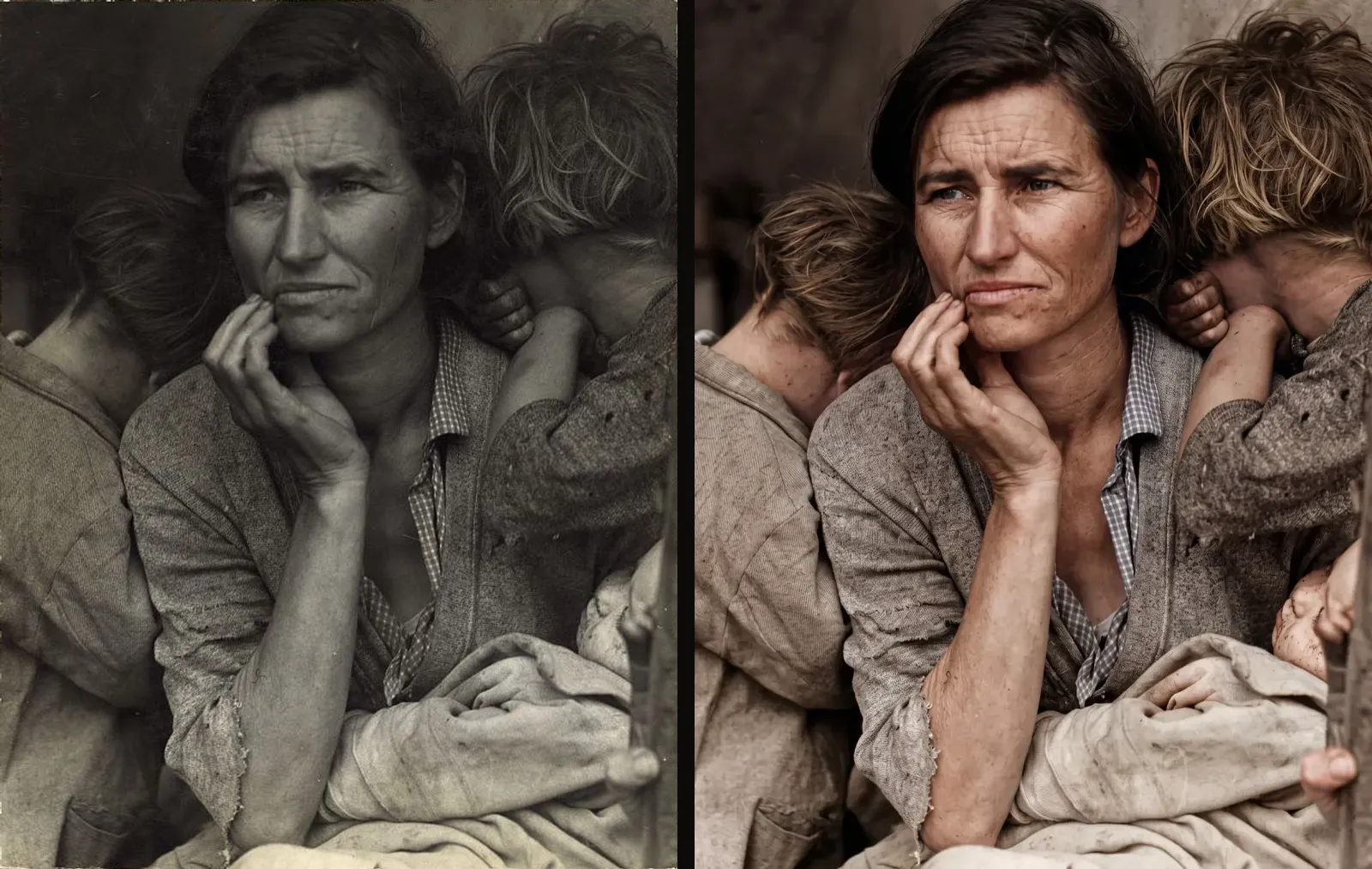
Dorothea Lange’s 1936 Migrant Mother from an unretouched print: the scratch across the face repaired, the thumb kept, the photograph in color.
- Photographer
- Dorothea Lange
- Date and place
- March 1936, Nipomo, California
- Damage
- Scratch across the face, losses on the top edge
- Archive
- Library of Congress, LC-DIG-ppmsca-12883
- Restoration
- Epoha
Free during early access · 2 restorations a day
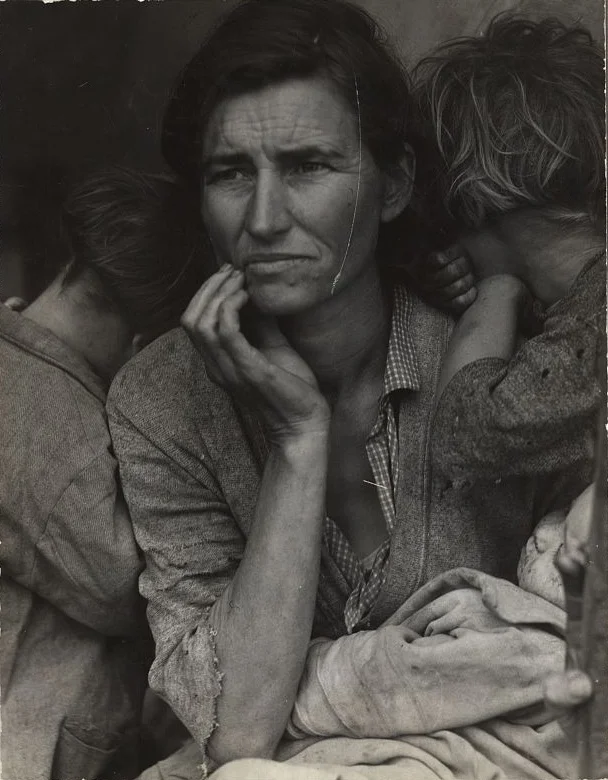
This is a physical print of the photograph Dorothea Lange made in March 1936 in Nipomo, California, held by the Library of Congress and scanned before its conservators treated it. A thin bright scratch runs down the mother’s face, and the print still shows something the best-known version of this photograph does not: a thumb at the right edge. What follows is what restoration repaired, what it left alone, and how the result compares with the Library’s own conservation of the same print.
What the photograph shows
Lange’s frame is close and upright. A woman looks away from the camera, off to the left, one hand against her chin. A child leans against her on either side, both with their faces turned from the lens, and a baby lies in her arms at the lower right. A wooden pole runs up the right edge of the picture. The Library of Congress catalogs it as “Destitute pea pickers in California. Mother of seven children. Age thirty-two. Nipomo, California,” dated March 1936, and notes that it shows Florence Thompson with three of her children; its research guide places it in a series Lange made of Thompson and her children at Nipomo that month.
Recalling the occasion in 1960, Lange said: “I did not ask her name or her history.” The Library’s guide quotes the line in its introduction. We name Thompson here because the Library does; beyond what the record says, this page makes no claims about her or her family.
What happened to this print
The Library’s record for this photograph lists several digital files, and they are not all the same picture. One is made from the original negative, in the retouched form most people know. Another is a film copy negative of what the record calls an “unretouched fileprint showing thumb.” The Library’s record says the negative was retouched in the 1930s to erase the thumb holding a tent pole in the lower right-hand corner.
Our starting point is the print the record itself points to: it names LC-DIG-ppmsca-12883 as the file print made before the thumb was retouched. The record lists two scans of that print, one made before conservation (LC-DIG-ppmsca-12883) and one after (LC-DIG-ppmsca-23845). We started from the pre-conservation scan. The Library’s own conservators have treated this print since; their post-conservation scan appears further down this page, next to our result.
The print is mounted on gray card. A typed caption on the mount reads “Destitute peapickers in California; a 32 year old mother of seven children. February, 1936.” The Library catalogs the sitting as March 1936. We report both dates as they appear. A handwritten note in red on the mount reads “Not for commercial use.” The Library’s rights statement for the photograph itself reads: “No known restrictions. For information, see U.S. Farm Security Administration/Office of War Information Black & White Photographs.”
On the print, a thin bright line, a scratch in the surface, runs from the forehead down past the nose and across the cheek to the chin. There are small white losses along the top edge.
What was repaired
The mount is not part of the picture, so we cropped it away by hand. In our run, the automatic frame detection cut off the right edge of the photograph, exactly where the thumb is, and the thumb is part of this print’s record. The restoration was generated with Gemini nano-banana 2.1 through our lab — a different image model from the one behind the restoration tool on this site — using the same analysis and instructions as that tool. We made three runs and show the one whose faces stayed closest to the print, judged by eye and by measurement.
The scratch across the face is gone, the small losses along the top edge are filled, and the photograph comes back in color.
The same print, after the Library’s conservators
The Library’s record also links a scan of this print made after conservation (LC-DIG-ppmsca-23845). Set beside our result, it shows two kinds of work. The conservators treated the object itself and kept it as it is: on their scan the scratch across the face can no longer be seen, and the softness, the warm tone of the print and the depth of the shadows are where they were. Epoha brings the picture back from a scan of that object — repaired, and in color.
The record does not say how the conservators treated the print, so we make no claim about their method.
Sources
- Destitute pea pickers in California. Mother of seven children. Age thirty-two. Nipomo, California — Dorothea Lange, 1936 March — Library of Congress, FSA/OWI collection
- Migrant Mother Series of Images — Dorothea Lange’s “Migrant Mother” Photographs in the Farm Security Administration Collection — Library of Congress Research Guides
A family print with a scratch across a face?
Upload a scan of your own — a scratched print, a crease, a faded corner — and see the result next to your original before you decide whether to keep it.
Free during early access · 2 restorations a day
Left alone on purpose
The thumb at the right edge of the frame is still there: the retouched negative removed it, this print keeps it, and so does the restoration. Lange’s framing, the children turning their heads away from the camera and the tent pole beside them are as she made them. We did not "correct" the mother’s expression, and nothing in the picture was moved.