Anna Pavlova, photographed by Arnold Genthe, 1915
Arnold Genthe photographed Anna Pavlova in 1915 on a nitrate negative clouded by silver mirroring. What restoration recovered, and what it only guessed at.
This is a nitrate negative of the dancer Anna Pavlova, made by the photographer Arnold Genthe on November 8, 1915, and held today by the Library of Congress. Decades in storage left it wrapped in silver mirroring, a metallic sheen that had swallowed most of the image before anyone tried to recover it digitally. What follows is what came back, what we deliberately left as it was, and where the negative's own record simply runs out.
What the photograph shows
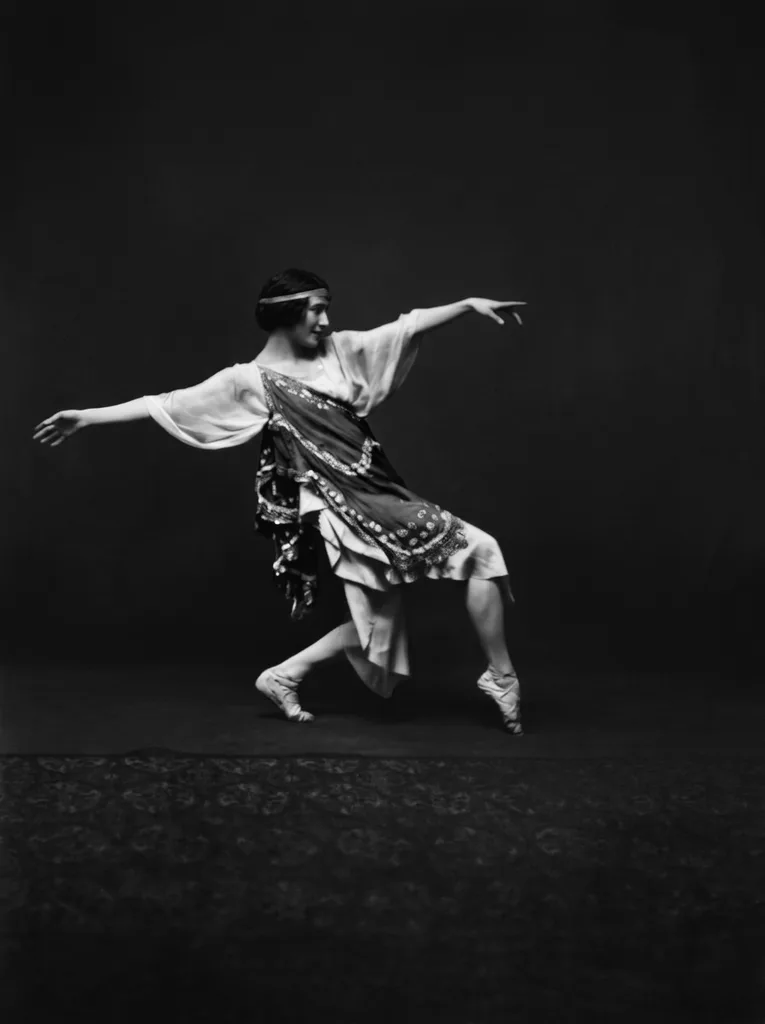
Genthe posed Pavlova full-length, mid-movement, against a plain dark studio backdrop: a pale, loose-fitting tunic wrapped in an embroidered cloth, a ribbon in her hair, arms spread wide, one foot raised onto pointe. The floor beneath her is dark as well, carrying a carpet pattern that barely survives in the negative. Neither the catalog record nor the image itself names a city or a specific performance, so none is claimed here.
What is certain is the date and the sitter — a dancer Genthe photographed at the height of a career that had already carried her, and the company she led, across stages worldwide, with her later years based in London. Genthe himself is better remembered today for two very different bodies of work: his portraits of dancers, Pavlova among them, and his photographs of San Francisco in the days after the 1906 earthquake.
What happened to the negative
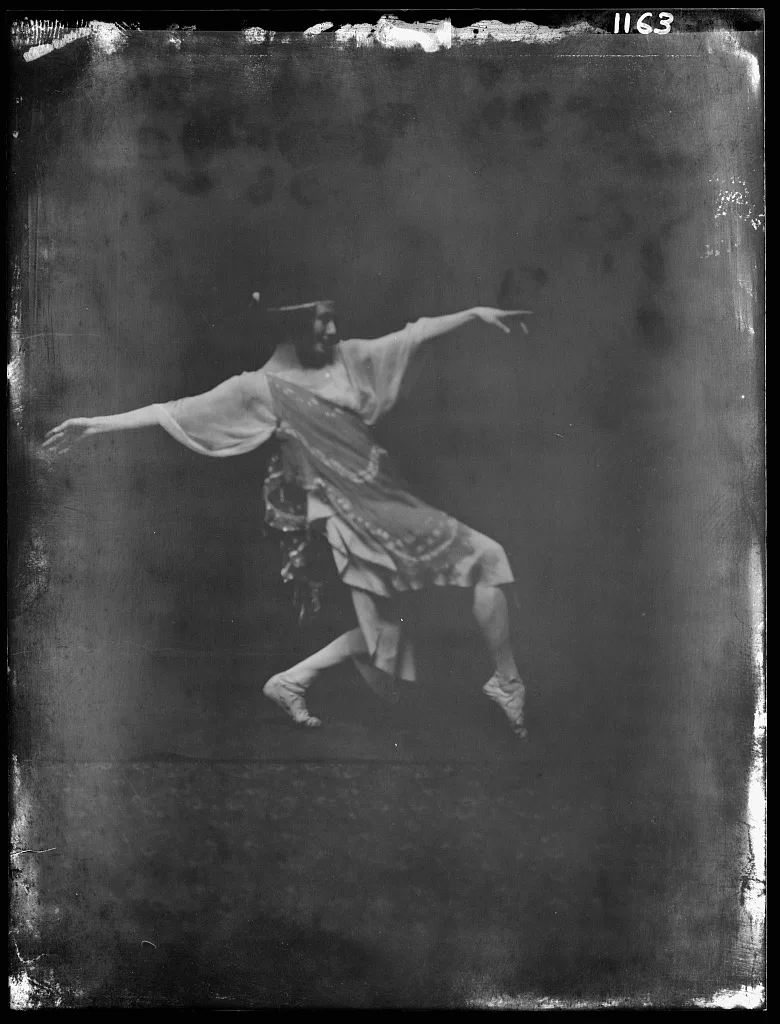
This exposure survives as a nitrate negative — the flexible, plastic-based film stock of the era, catalogued as LC-G39-1163 in Genthe's collection. Negatives of this era age in several ways at once, and the one that dominates here is silver mirroring: metallic silver from the image itself migrates to the surface of the emulsion and settles there as a faint reflective layer, usually thickest in the darkest parts of the frame. Left unaddressed, that layer sits over the picture like a dark, faintly metallic film. This is the same kind of damage our guide to restoring old negatives covers in more depth, including what a scan can and cannot recover from it.
On this particular negative the effect was unusually advanced. The Library of Congress's own curatorial essay on the Genthe negatives singles this one out, noting that it "exhibits a more advanced stage of deterioration" than most of the collection, with mirroring across the image and staining along the borders. In the upper right corner, someone had also marked the plate with its archive number, 1163, in white paint directly on the emulsion, and the edges of the plate itself are uneven where the nitrate stock was trimmed.
What was repaired, and where the record ends
Restoration lifted the mirroring and returned the tones to something close to their working range: the tunic reads pale again, the studio backdrop reads a deep, even black, and the stains and abrasions along the edges are gone. The archive number "1163" and the negative's uneven cut edges are gone too — both were marks on the plate, not part of the photograph Genthe took, so removing them is closer to cleaning the window than editing the view through it. The carpet pattern on the floor is also clearer now than it is on the negative itself; some of that clarity is genuine recovery, and some of it is reconstruction from the surrounding texture, filling in a pattern the damaged negative only partly kept.
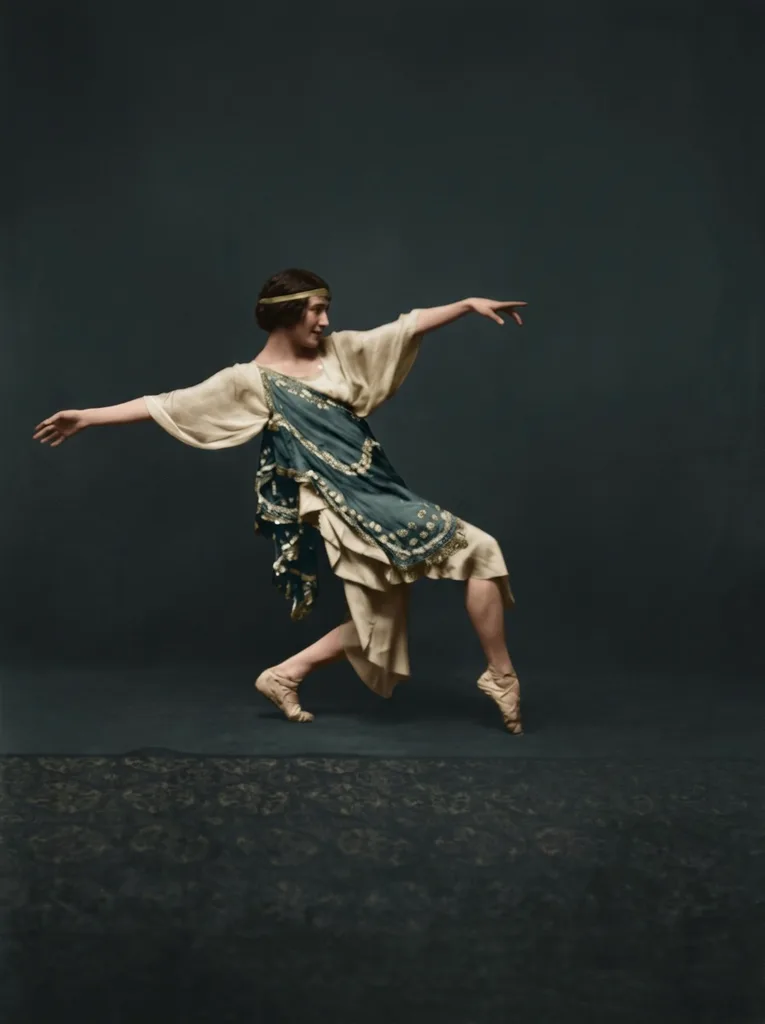
The tool also returned a colour version of the same photograph, built from the same file. What that version knows, and what it is only guessing at, is a different question from everything above — and it is honest enough that we are showing it separately rather than folding it into the main result.
Sources
- Pavlova, Anna, Madame — Arnold Genthe, 1915 Nov. 8 — Library of Congress, Genthe collection
- Deterioration and Preservation of Negatives, Autochromes, and Lantern Slides — Negatives — Library of Congress, Genthe collection
See what restoration does with a photograph of your own
Upload a damaged scan — a mirrored negative, a stained print, a torn corner — and see the result before you decide whether to keep it.
Epoha is in early access: restoration is free and there is nothing to pay yet.
The softness across Pavlova's arms and skirt is original to the 1915 exposure — a dancer caught mid-movement by a shutter the studio's light required and the film of the day could not outrun — and restoration left it alone rather than inventing a sharpness the camera never recorded. Her pose, silhouette, costume and facial features were not altered; an automated comparison against the original scored the restored face a 0.99 match out of 1, a measurement from our own tool, not an independent study. The negative itself, held by the Library of Congress under call number LC-G39-1163, was not touched — what you see here is a digital copy, not a treatment of the object.