Jack London, photographed by Arnold Genthe
Arnold Genthe's glass negative of Jack London cracked and lost a corner in storage. What restoration rebuilt, what it left alone, and what is guesswork.
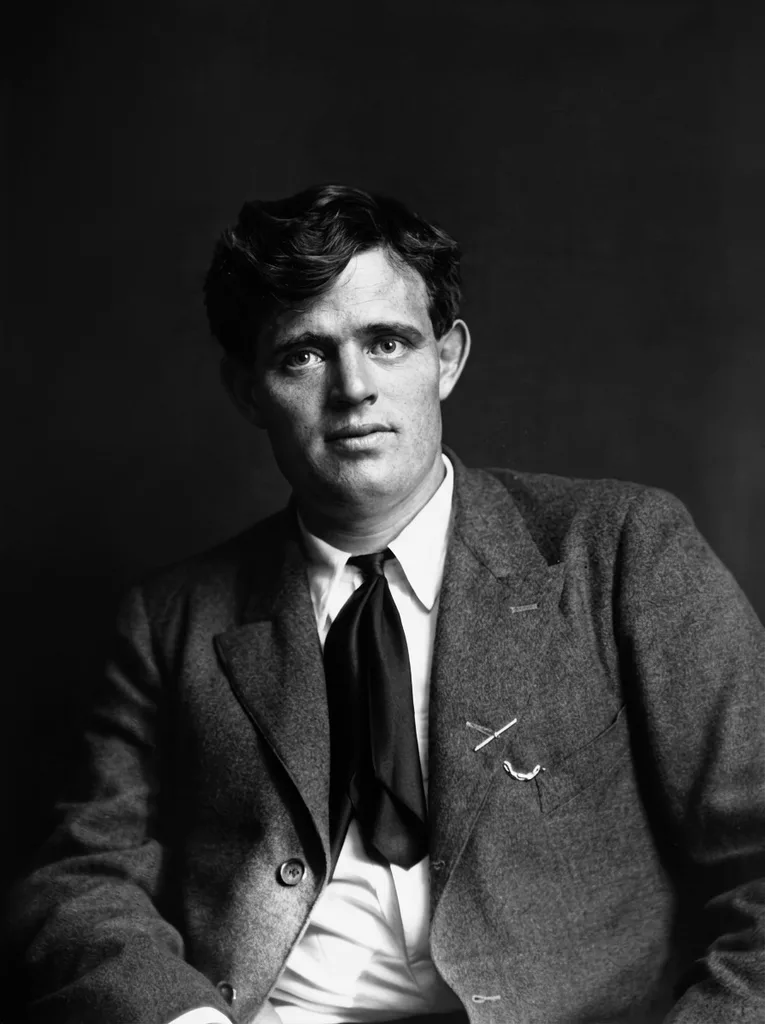
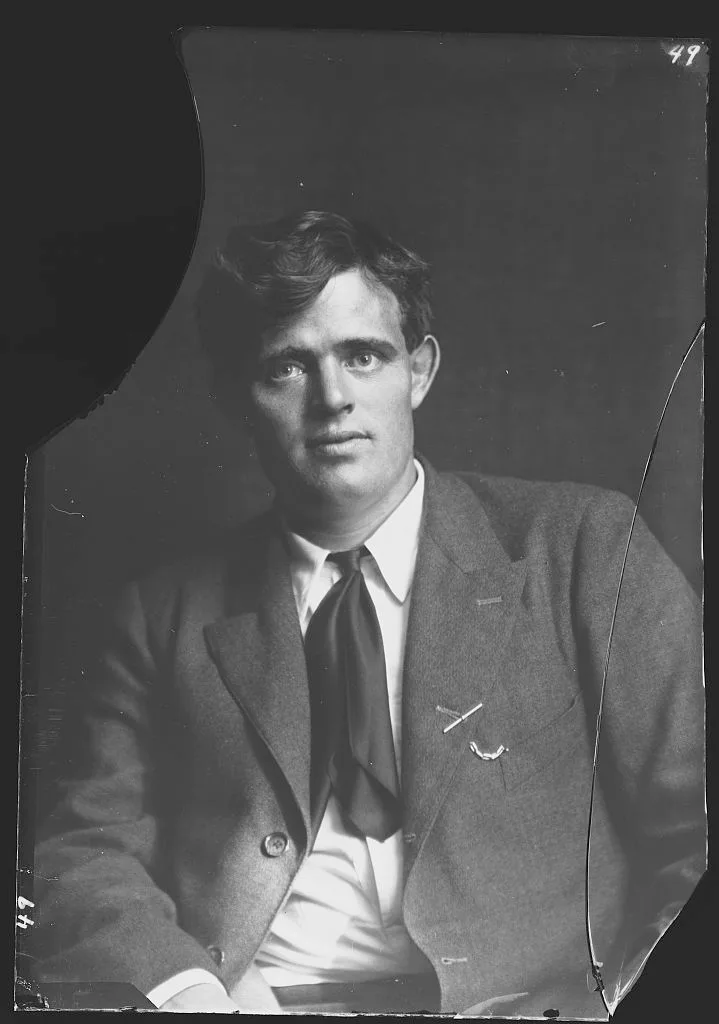
This is a glass-plate negative portrait of the writer Jack London, made sometime between 1906 and 1916 by the photographer Arnold Genthe and held today by the Library of Congress. At some point in the century since, the plate cracked and lost its upper-left corner outright, taking a piece of the image with it before anyone tried to repair the picture digitally. What follows is what came back, what stayed exactly as it was, and one small detail that almost didn't survive the process.
What the photograph shows
Genthe posed London for a half-length studio portrait, facing the camera directly: tousled hair, a steady gaze, a light shirt under a wide dark bow tie, a tweed jacket with a small pin on the left lapel, against a plain, even dark backdrop. The Library of Congress catalogs it simply as "London, Jack, portrait photograph," with no sitting, studio or city on record — so none is claimed here, and the date is given only as the decade the catalog allows.
What is certain is the sitter and the photographer. London was, by then, one of the most widely read writers in the country, author of The Call of the Wild and White Fang. Genthe is remembered mainly for two bodies of work: portraits like this one, and his photographs of San Francisco after the 1906 earthquake.
What happened to the negative
This portrait survives as a glass negative, catalogued in the Genthe photograph collection under call number LC-G389-0049. Glass is a rigid, brittle support, and a plate handled, stored upright or jostled for a century tends to fail the way glass fails: it cracks, and pieces break off, rather than merely scratching or fading the way film and paper do. The Library of Congress's own curatorial essay on the deterioration of the Genthe negatives names this exact plate, noting that it "suffered breakage along both edges" and that "the piece broken from the upper left corner is now lost." That is not figurative — the missing fragment of glass, and whatever image sat on it, is gone.
On the scan, that loss shows as a large black arc eating into the upper-left corner, where there was no plate left to hold an image. A second crack runs down the right edge, with a smaller break at the lower right, and the plate's cut edges are uneven throughout. In the upper-right corner, someone marked the plate with its archive number, 49, in white paint directly on the glass. Our guide to restoring old negatives covers this kind of support damage — cracked and broken glass and film plates — including what a scan can and cannot recover from it.
What was repaired, and where the record ends
The missing corner is filled with a continuation of the plain dark studio backdrop — reasonable, since the backdrop is all that region of the plate ever held, but still a reconstruction, not a recovered record: no negative exists of that fragment, so nothing was actually read back from it. The same caution applies to any repair of a genuinely missing area, the subject of our guide to restoring photos with missing pieces. The crack down the right edge and the break at the lower right are gone in the result, and so are the archive number and the plate's ragged cut edges — both are marks on the glass, not part of the photograph Genthe took, so removing them is closer to cleaning the window than editing the view through it. London's face, gaze, hair, tie and jacket were not altered.
One detail deserves stating plainly: the small pin on London's left lapel. Across three test runs on this negative, it disappeared twice — quietly smoothed away as if it had never been there — and survived intact in only one, which is the run we kept. That is exactly the kind of small, easy-to-miss mark a careless restoration erases first, and why every result here gets checked against the original rather than accepted on faith. We skipped an automated face-match score for this one: on a soft glass negative like this, that measurement tends to read low regardless of how faithful the result is. Instead we checked by eye against the original — eyebrows, the spacing between the eyes, the line of the mouth — and the face that came back is his.
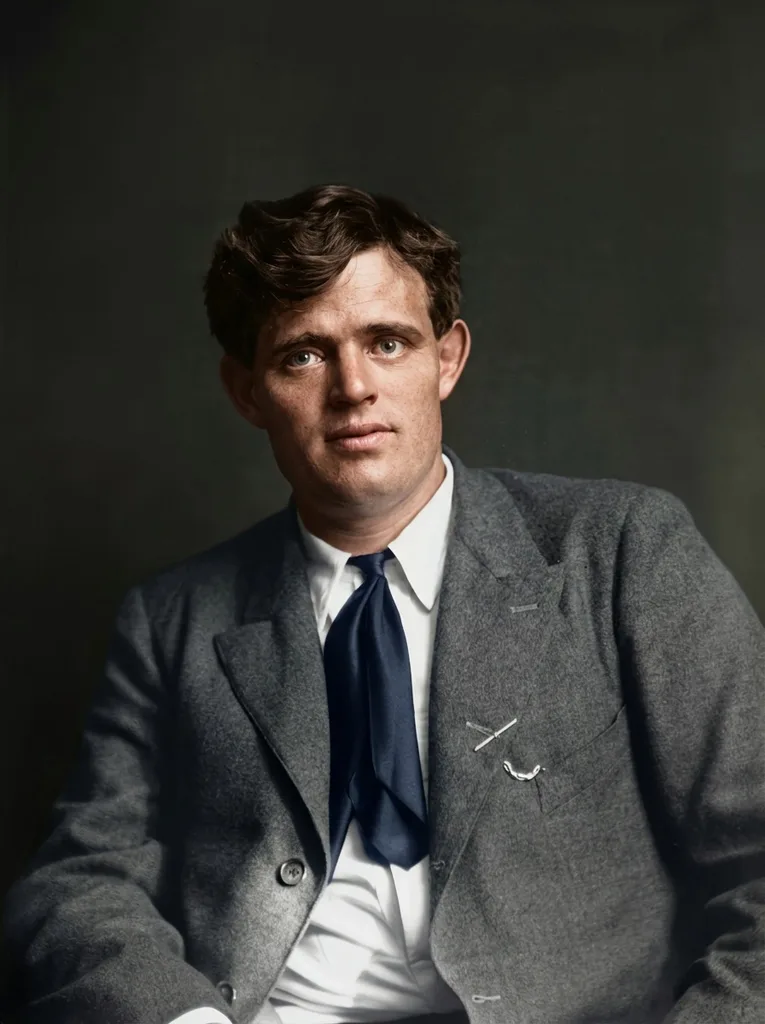
The tool also returned a colour version of the same portrait, from the same file. What it knows and what it is only guessing at is a separate question, answered below rather than folded into the main result.
Sources
- London, Jack, portrait photograph — Arnold Genthe — Library of Congress, Genthe collection
- Deterioration and Preservation of Negatives, Autochromes, and Lantern Slides — Negatives — Library of Congress, Genthe collection
See what restoration does with a photograph of your own
Upload a damaged scan — a cracked negative, a broken corner, a stained print — and see the result before you decide whether to keep it. Restoration is free during early access.
Epoha is in early access: restoration is free and there is nothing to pay yet.
The soft focus across London's hands and the lower edge of his jacket is original to the exposure, not a flaw restoration was asked to fix, and the slight softness in his hair was left the same way. Lighting and composition are Genthe's, untouched. His face was not smoothed or reshaped, and no sharpness was invented where the negative simply never recorded any — what looks soft in the original still looks soft here.