Frances Benjamin Johnston and "Pops" Whitesell, New Orleans
Frances Benjamin Johnston and "Pops" Whitesell in a New Orleans garden, 1945-1952: what a dust-marked, torn-edged print looked like, and what came back.
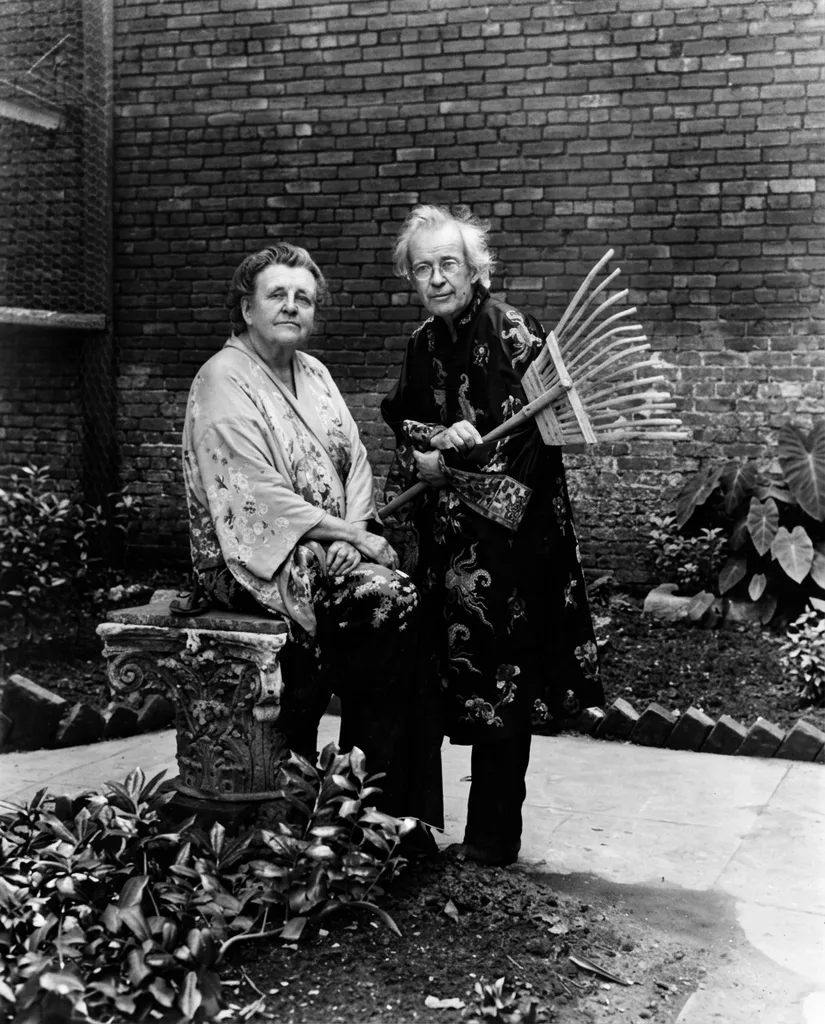
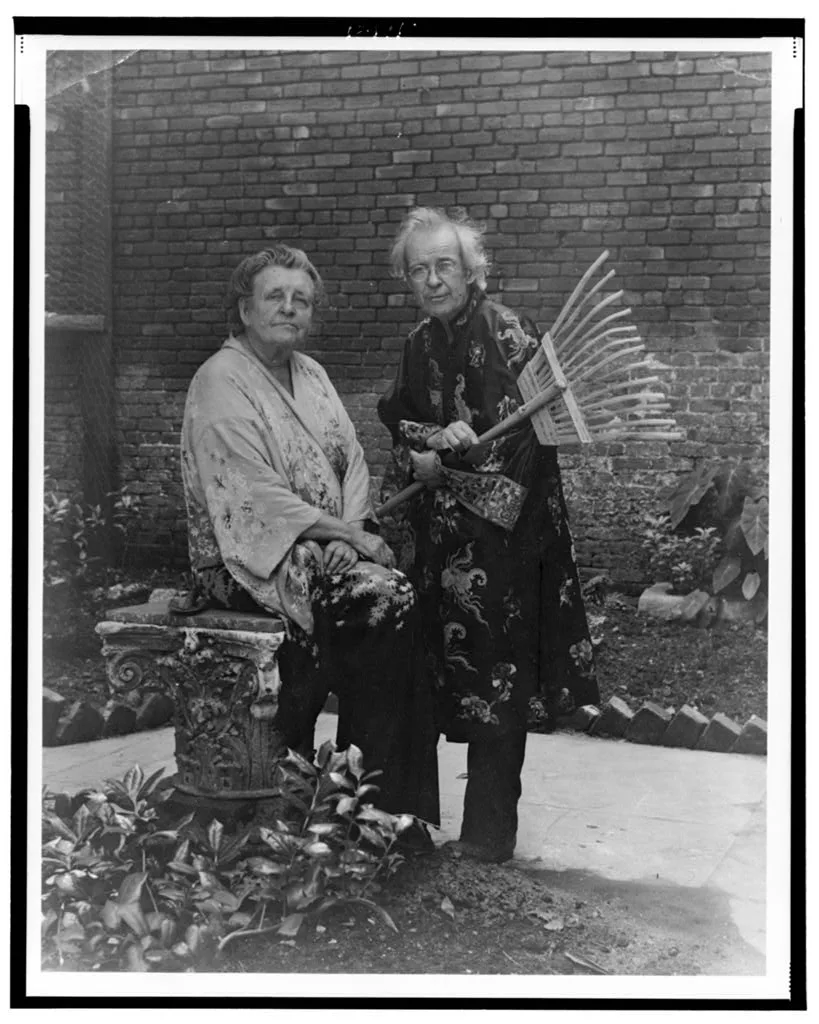
This is a gelatin silver print from the Frances Benjamin Johnston Collection at the Library of Congress: Johnston herself, seated in a New Orleans garden sometime between 1945 and 1952, beside the photographer "Pops" Whitesell, who stands holding a rake. Dust, small speckling and a torn sheet edge had settled onto the print by the time it was scanned. What follows is what came back, what the tool could only clean rather than mend, and where two faces made the difference between a run we kept and two we set aside.
What the photograph shows
The catalog title places the two of them plainly: "Frances B. Johnston in garden in New Orleans with 'Pops' Whitesell, who is holding a rake." The scene backs that up. Johnston sits on the stone capital of a garden column, in a light kimono patterned with flowers, in a walled brick courtyard crowded with plants. Beside her stands Whitesell — thin, gray-haired, bespectacled, in a dark robe embroidered with dragons — a wooden rake propped on his shoulder. Both look straight at the camera, and the print sits on a sheet with plain white margins, the paper of its era.
Johnston, by then in her eighties, was one of the first American women to work as a photojournalist and documentary photographer, known earlier in her career for portraits and for documenting the architecture of the American South; she spent her later years in New Orleans. Whitesell was a photographer known in the city's own bohemian circles, and here he appears exactly as the catalog describes him: a man holding a rake in a garden. Neither the occasion nor the photographer who made this particular exposure is named in the record — it survives because it belonged to Johnston's own collection, not because she is credited with taking it.
What happened to the print
The print is a gelatin silver print, the standard photographic paper of the mid-twentieth century, on a sheet larger than the image itself: 26 by 21 centimeters of paper carrying a 24 by 19 centimeter photograph, with a plain margin around it. The Library of Congress catalog notes plainly that this sheet's right edge is torn. Dust and small dark speckling had also settled across the printed surface over the decades, along with light abrasions and the general softness of a well-handled, mid-century print rather than a studio portrait kept under glass.
A torn sheet edge like this is a defect of the paper support, not of the image printed on it — the kind of damage our guide to repairing a torn photo addresses directly, including why reaching for tape only makes a torn print harder to scan and to fix later. Dust and surface marks, by contrast, sit on top of the emulsion and can be lifted without guessing at anything the camera didn't record.
What was repaired, and where the record ends
Restoration lifted the dust and speckling from the print and returned contrast to the courtyard's brick wall and the pattern on both robes, which now reads clearly where the damaged scan did not allow it. The torn edge of the sheet is gone from the result — but not because it was repaired. Our tool returns only the photographic image, not the sheet's margins, so a defect that sat on the paper outside the picture simply falls outside the frame it hands back. That is a crop, not a mend, and it is worth saying plainly: the paper this print is on is still torn; only the image drawn from it looks whole.
Both faces were checked against the original print rather than accepted on trust. We ran the restoration three times; in two of the three, Johnston's and Whitesell's faces stayed close to what the print actually shows, and in the third, one of the two faces drifted from it — a small shift that would go unnoticed by anyone who hadn't looked at the original first. We kept the run where both faces held and set the other aside. Nothing about the courtyard, the rake or the two people in it was invented beyond that choice.
The tool also returned a colour version of this same portrait, built from the same file. What it knows and what it is only guessing at is a separate question, answered below rather than folded into the main result.

Sources
- Frances B. Johnston in garden in New Orleans with "Pops" Whitesell — Library of Congress, Frances Benjamin Johnston Collection
See what restoration does with a photograph of your own
Upload a damaged scan — a torn sheet, dust, faded contrast — and see the result before you decide whether to keep it. Restoration is free during early access.
Epoha is in early access: restoration is free and there is nothing to pay yet.
The soft grain and gentle blur across both figures are original to this gelatin silver print — an ordinary snapshot softness, not a flaw the tool was asked to fix — and the dry midday light on the brick wall behind them was left as photographed rather than pushed brighter or sharper than the print actually holds. Neither face was smoothed, reshaped, or made younger. Both were checked by eye against the original print, and the version kept here is the one where Johnston's and Whitesell's faces stayed closest to it, out of three attempts.