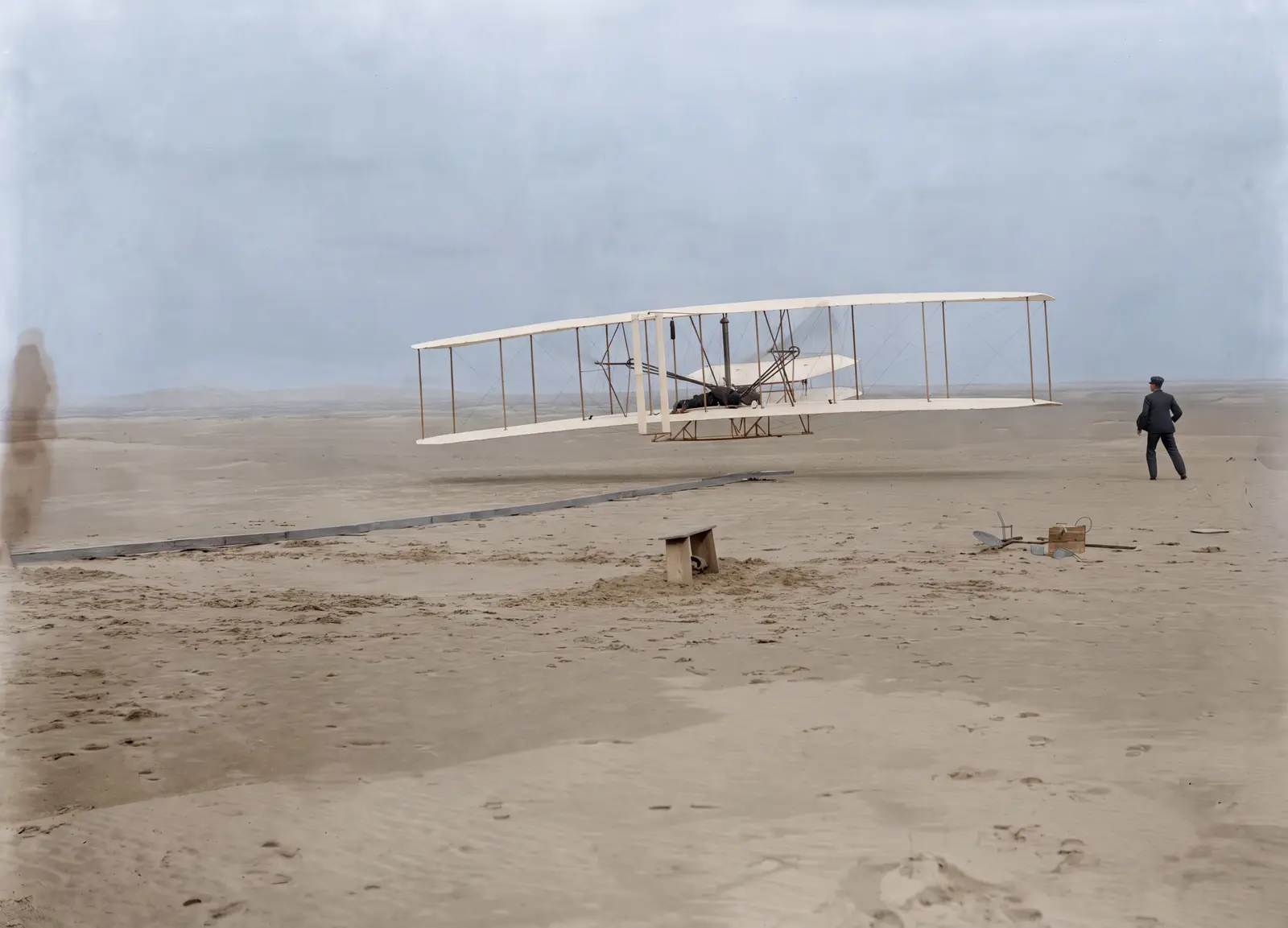
- Photograph — Attributed to Wilbur and/or Orville Wright
- Date and place — December 17, 1903, Kitty Hawk, North Carolina
- Damage — Broken corner, blotches, black plate border
- Archive — Library of Congress, LC-DIG-ppprs-00626
- Restoration — Epoha
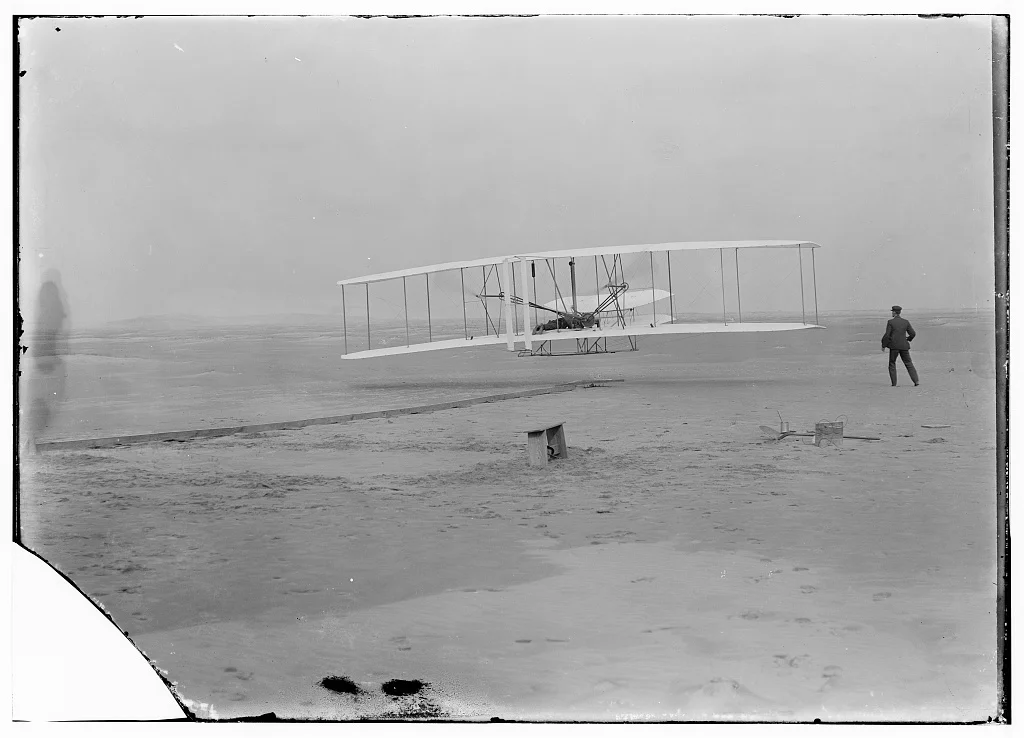
The first flight, 1903
The Wrights’ 1903 first-flight glass negative, with its broken corner filled and the blotches gone, restored and brought back in color.
- Photograph
- Attributed to Wilbur and/or Orville Wright
- Date and place
- December 17, 1903, Kitty Hawk, North Carolina
- Damage
- Broken corner, blotches, black plate border
- Archive
- Library of Congress, LC-DIG-ppprs-00626
- Restoration
- Epoha
Free during early access · 2 restorations a day
This is the Library of Congress’s digital file of a glass-plate negative exposed at Kitty Hawk, North Carolina, on December 17, 1903: the first flight of the Wright brothers’ aircraft, caught as it left the ground. The lower-left corner of the plate has broken away, dark blotches mark the bottom edge, and a black border runs around the picture; the plate’s history includes a flood. What follows is what restoration repaired and what it left alone.
What the photograph shows
The frame is wide and nearly empty. A biplane hangs just above a bare beach, seen from the side, its long pale wings set against a flat gray sky. A man in a cap and dark jacket stands on the sand at the right, his back to the camera. A rail runs in from the left edge, and footprints cover the ground. The catalog lists what else is on the sand: the starting rail, the wing-rest, a coil box and other items needed for flight preparation.
The Library of Congress catalogs it as “[First flight, 120 feet in 12 seconds, 10:35 a.m.; Kitty Hawk, North Carolina],” dated December 17, 1903. The catalog describes Orville Wright at the controls, lying prone on the lower wing, and Wilbur running alongside to balance the machine, having just released his hold on the right wing — he is the man at the right. According to the National Park Service, Orville released the restraining wire at 10:35.
The catalog attributes the photograph to Wilbur and/or Orville Wright, and its description says how it was taken: Orville preset the camera and had John T. Daniels squeeze the rubber bulb, tripping the shutter. The park service tells it the same way — Daniels was one of the men from the nearby lifesaving station. The Library’s rights statement reads: “No known restrictions on publication.”
What happened to the negative
The plate, digitized by the Library as LC-DIG-ppprs-00626, is one of 303 glass negatives the Library of Congress acquired in 1949 from the estate of Orville Wright. According to the Library’s essay on the Wrights’ photography, nearly all of them were taken and developed by the Wrights themselves between 1898 and 1911, in a darkroom in a small backyard shed at their home on Hawthorn Street in Dayton.
The Dayton flood of March 25–27, 1913, damaged the Wright home and the wooden shed where the negatives were stored. The essay says that few, if any, of the cracks and blemishes on the plates were caused by the Wrights; they are the result of the flood. It adds that a print made from a plate before the flood might be in better condition than the negative is today.
On our scan, the lower-left corner of the glass is broken away, leaving a white area where there is no plate. Dark blotches sit near the bottom edge, and the black border of the plate surrounds the picture. At the left edge, a dark, blurred upright shape stands in the sand and sky; nothing in the record explains it. We do not claim the flood broke this particular corner: the essay speaks of the plates in general. Our guides to water damage, missing pieces and negatives cover these kinds of loss.
What was repaired
The restoration was generated with Gemini nano-banana 2.1 through our lab — a different image model from the one behind the restoration tool on this site — using the same analysis and instructions as that tool. We made three runs and show one. One of the other two removed the dark shape at the left; the third kept it too and differed from the one shown only in small details.
The broken corner is filled, the blotches at the bottom are gone, the black border of the plate is replaced by more picture, and the photograph comes back in color. We left the dark shape at the left edge in place, since the record does not explain what it is.
Sources
- [First flight, 120 feet in 12 seconds, 10:35 a.m.; Kitty Hawk, North Carolina] — Library of Congress, Wright Brothers Negatives
- Photography and the Wright Brothers — Library of Congress, Wilbur and Orville Wright Papers
- 1903 — The First Flight — National Park Service, Wright Brothers National Memorial
A family print that has been through water, or lost a corner?
Upload a scan of your own — a water-stained print, a broken corner — and see the result next to your original before you decide whether to keep it.
Free during early access · 2 restorations a day
Left alone on purpose
The dark, blurred shape at the left edge stays, because we cannot tell from the record whether it is damage or something in the scene. Wilbur’s pose, the starting rail, the wing-rest, the coil box and the other items on the sand, the flat overcast light and the composition are as the plate holds them.