
- Photographer — Robert Cornelius (1809–1893), self-portrait
- Date and place — October or November 1839, Philadelphia
- Damage — Hundreds of white spots, haze, tarnish at the edges
- Archive — Library of Congress, LC-DIG-ppmsca-40464
- Restoration — Epoha
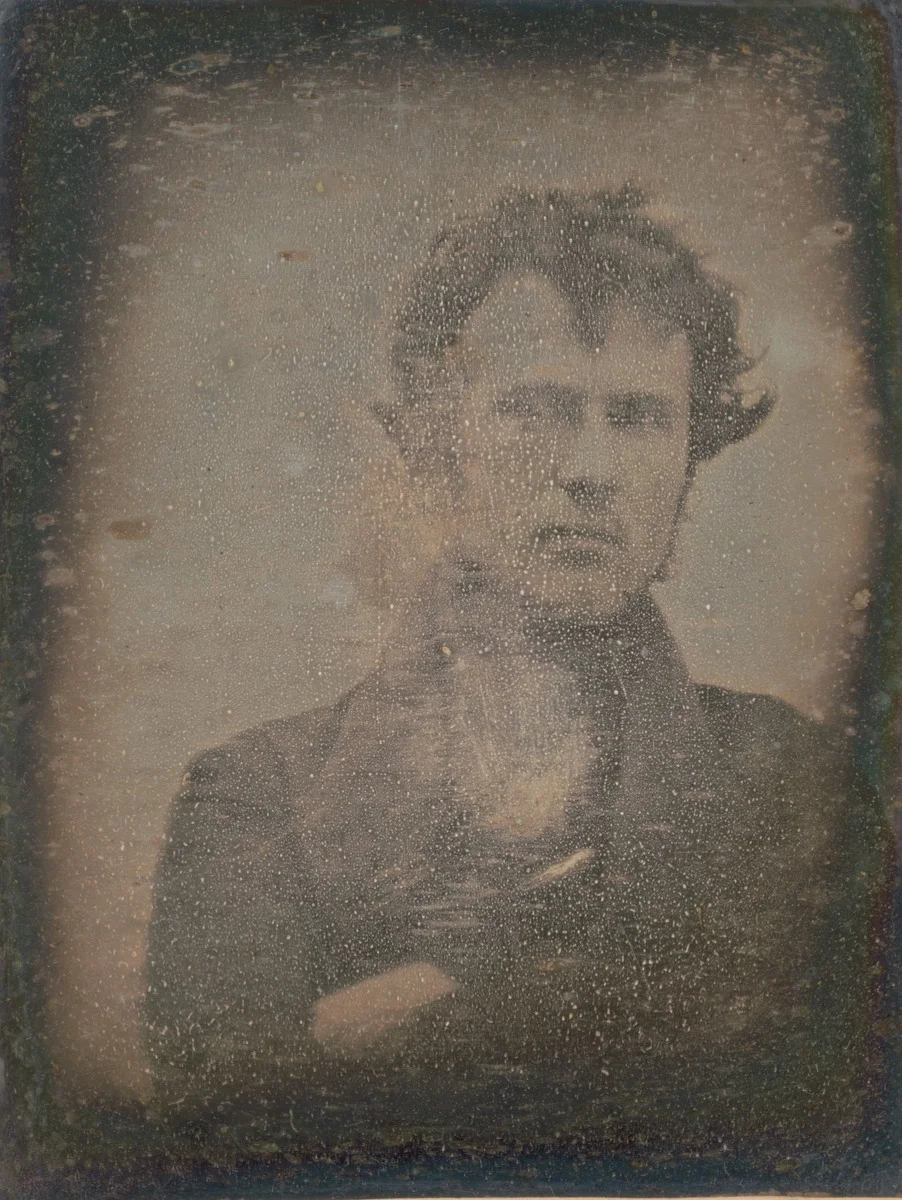
The first selfie, 1839
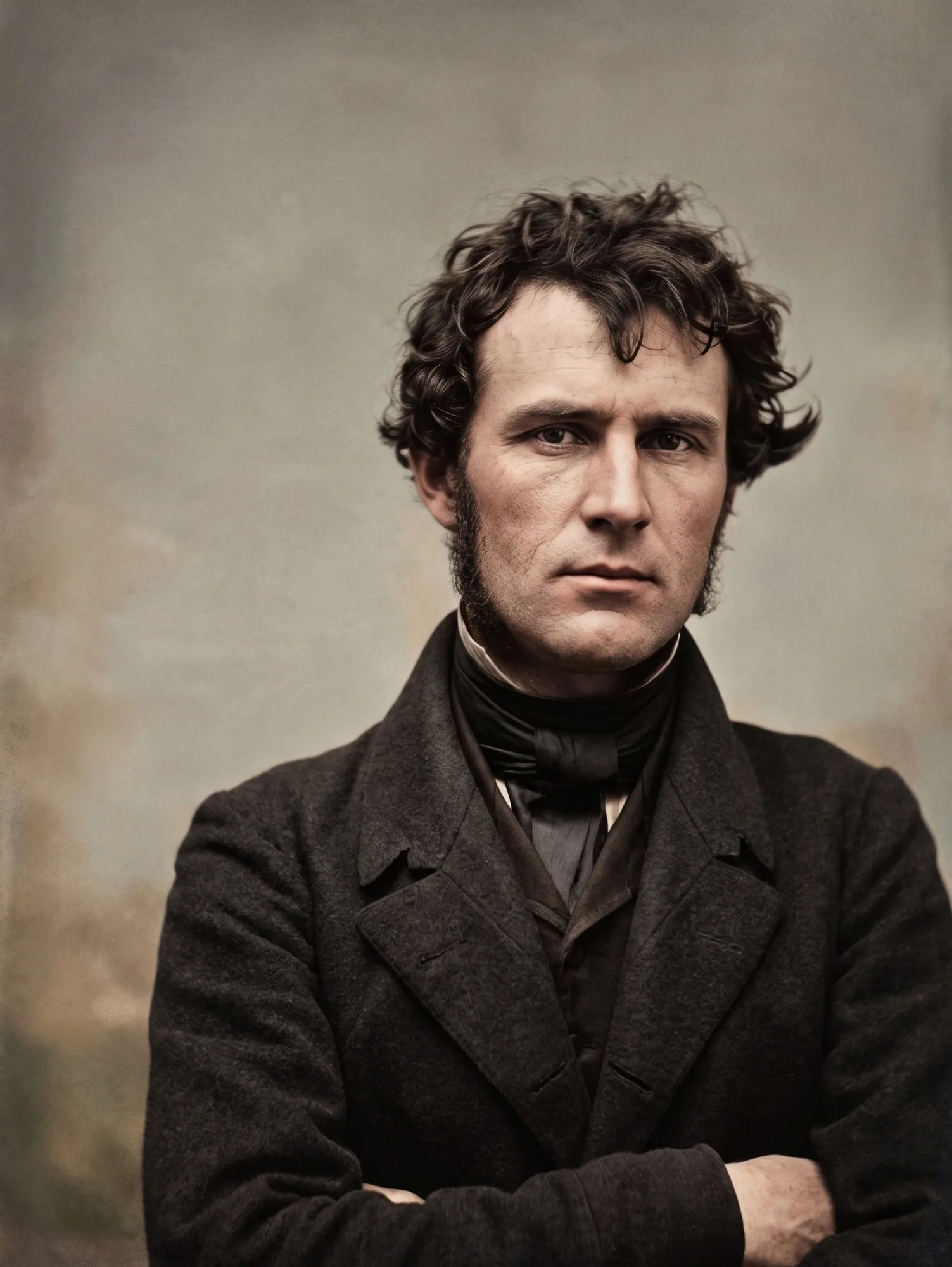
Robert Cornelius’s 1839 daguerreotype, often called the first selfie, restored: the white spots and haze removed and the color inferred by AI.
- Photographer
- Robert Cornelius (1809–1893), self-portrait
- Date and place
- October or November 1839, Philadelphia
- Damage
- Hundreds of white spots, haze, tarnish at the edges
- Archive
- Library of Congress, LC-DIG-ppmsca-40464
- Restoration
- Epoha
Free during early access · 2 restorations a day
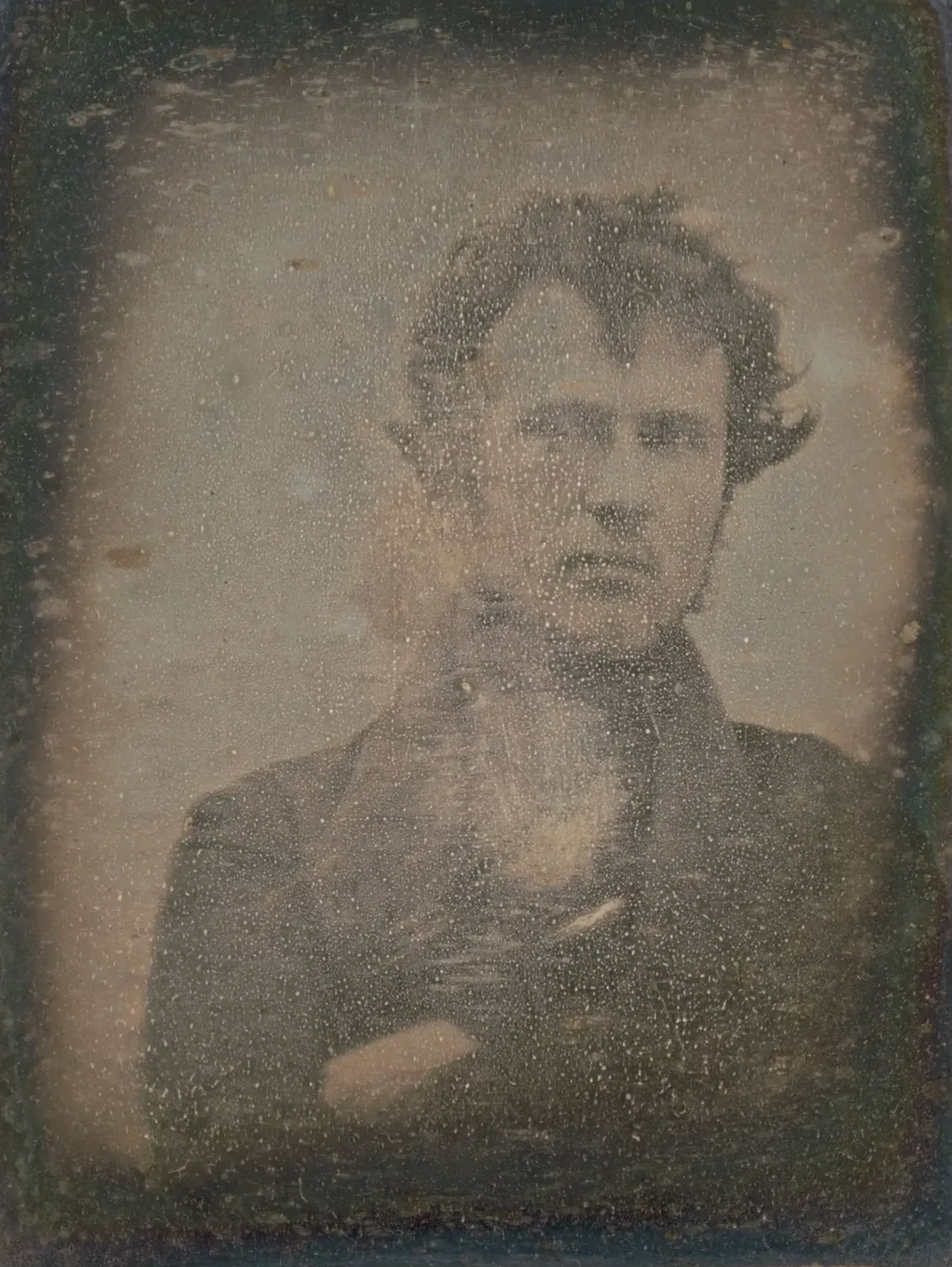
Robert Cornelius’s self-portrait of 1839, often called the first selfie, is a small daguerreotype that the Library of Congress catalogs as “believed to be the earliest extant American portrait photo.” Hundreds of small white spots and a pale haze cover the plate’s silver surface, tarnish darkens its edges, and under the spots the face is barely legible. What follows is what the record says about the plate, what restoration repaired, and what it could not recover.
What the first selfie shows
A young man faces the camera, his arms crossed over a dark coat and his hair askew. The catalog calls it a head-and-shoulders self-portrait and places him slightly off-center, outdoors in the yard behind his family’s lamp and chandelier store, “peering uncertainly into the camera.” The background on the plate is a pale, empty field, and nothing of the yard shows in it.
The record’s title is “[Robert Cornelius, self-portrait; believed to be the earliest extant American portrait photo],” and a note adds “Title devised by Library staff.” It dates the plate “1839 [Oct. or Nov.]” and names Robert Cornelius (1809–1893) as the photographer. The word selfie does not appear in it. The claim it makes is narrower than the nickname: the earliest surviving American portrait photograph. It does not say this is the first photograph of a person anywhere.
The record’s notes also describe how it was made. A young Philadelphian, working outdoors “to take advantage of the light,” used “a box fitted with a lens from an opera glass,” within months of Daguerre’s August 1839 announcement of his process to the French Academy of Sciences. The notes add that early daguerreotypy needed exposures of three to fifteen minutes. They say that of the process in general; the record gives no exposure time for this plate.
What happened to the plate
The object is what the catalog calls an “approximate quarter plate daguerreotype”: an image on a polished, silvered metal plate. The visible plate measures 9 by 6.9 centimeters (about 3.5 by 2.7 inches), a little larger than a playing card, and sits in a mount of 37.6 by 29.1 centimeters (about 14.8 by 11.5 inches).
A note records an inscription on the paper backing: “The first light picture ever taken. 1839.” The record does not say who wrote it or when. The inscription claims more than the Library’s own description does. The date is not settled either. The catalog gives “1839 [Oct. or Nov.]”; the first note says “October or November, 1839,” and the second, which credits Carol Johnson’s 1999 “Photographic Material,” says “That October.”
The record lists four digital files: one from the original plate (LC-DIG-ppmsca-40464) and three from film copies of it, a color transparency, a color slide and a black-and-white copy negative. We worked from the file of the original. The Library’s record for its daguerreotype collection says the collection includes “… the first American daguerreotype, made by Robert Cornelius,” a less hedged wording than this item’s own. The item’s notes do not say when or how the plate came to the Library. Its rights statement reads: “No known restrictions on publication.”
What was repaired
Restoration removed the white spots and the haze, and the portrait comes back in color. The plate sits in a large paper mount, so we cropped it out by hand and ran the restoration without automatic cropping. The restoration was generated with Gemini nano-banana 2.1 through our lab — a different image model from the one behind the restoration tool on this site — using the same analysis and instructions as that tool.
Our first three runs, on the Library’s 1024-pixel file, gave a face that was not his; the plate we had cropped from that file measured only 478 × 636 pixels. We discarded them and started again from the Library’s full-resolution master scan, 4896 × 5748 pixels; the crop we fed the model from it measured 1503 × 2000. The three runs from the master differ from one another in the face, the hair and the color of the coat, so we show the one whose face is closest to the plate, judged by eye and by our face-similarity measurement.
Where the spots cover the face, the plate no longer holds the detail, so what you see there is the model’s reconstruction — hold the photograph to compare it with the original.
The color is inferred by the model, not recovered from the photograph, which is black and white. The brown coat, the dark neckcloth, the warm skin and the gray-beige background are the model’s guesses.
Questions about the first selfie
Who took the first selfie, and how?
Robert Cornelius, a young Philadelphian, according to the Library of Congress, which holds the daguerreotype and catalogs it as a self-portrait from October or November 1839. Its notes say he worked outdoors, in the yard behind his family’s lamp and chandelier store, with a box fitted with a lens from an opera glass.
When was the first selfie taken?
In October or November 1839. That is the Library’s dating, “1839 [Oct. or Nov.],” and it puts the plate within months of Daguerre’s August 1839 announcement of his process. The record gives no day.
Was this really the first selfie ever taken?
It is the plate usually given as the answer, but the catalog is more careful than the nickname. It calls the plate “believed to be the earliest extant American portrait photo,” the earliest surviving American portrait photograph, and does not say it is the first photograph of a person anywhere. The word selfie is not in the record.
Is there a real color photo of the first selfie?
No. The daguerreotype is real, but it records light and shade only, so the color on this page is inferred by the model: a brown coat, a dark neckcloth, warm skin, a gray-beige background. The Library’s record also lists copies made on color film, but they copy the same plate. Holding the photograph at the top of this page shows the original in place of our version.
Where is the original first selfie?
In the Library of Congress’s daguerreotype collection, catalog record 2004664436, digital file LC-DIG-ppmsca-40464. The record states “No known restrictions on publication,” and its link is under Sources at the foot of this page.
Sources
- [Robert Cornelius, self-portrait; believed to be the earliest extant American portrait photo] — Library of Congress, Daguerreotype Collection
A family print covered in spots or tarnish?
Upload a scan or a photo of your own — a daguerreotype shot through its case glass, a tintype, a print gone spotty. When the result is back, hold the restored photo to see your original before you decide whether to keep it.
Free during early access · 2 restorations a day
Used only to restore your photo. How we handle your photo
Left alone on purpose
The crossed arms, the hair standing askew and the head-and-shoulders framing are as the plate holds them. Nothing in the picture was moved, and the hair was not combed.