

- Photograph — Bain News Service, photographer not named
- Object — Glass negative, 8 × 10 in.
- Date — None recorded in the catalog
- Damage — Scratches, lifting emulsion, chipped edges
- Archive — Library of Congress, LC-DIG-ggbain-01887
- Restoration — Epoha
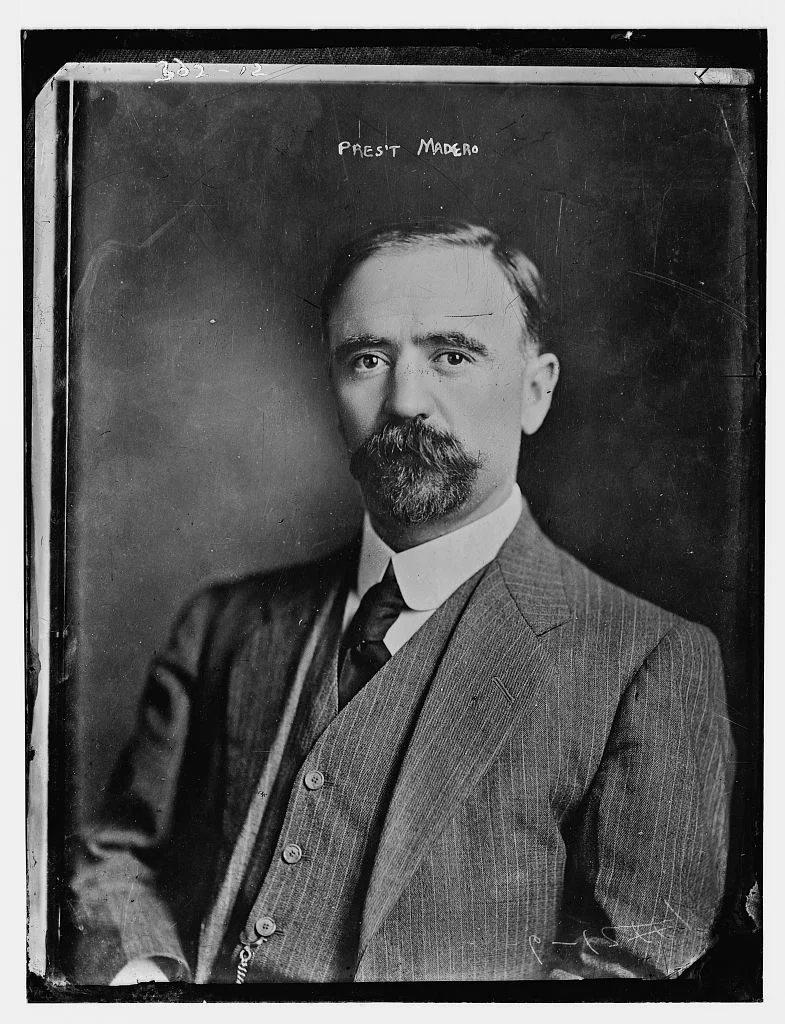
Francisco I. Madero, undated portrait
Francisco I. Madero on an undated Library of Congress glass negative: scratches and lifted emulsion repaired, the portrait colorized, the record explained.
- Photograph
- Bain News Service, photographer not named
- Object
- Glass negative, 8 × 10 in.
- Date
- None recorded in the catalog
- Damage
- Scratches, lifting emulsion, chipped edges
- Archive
- Library of Congress, LC-DIG-ggbain-01887
- Restoration
- Epoha
Free during early access · 2 restorations a day
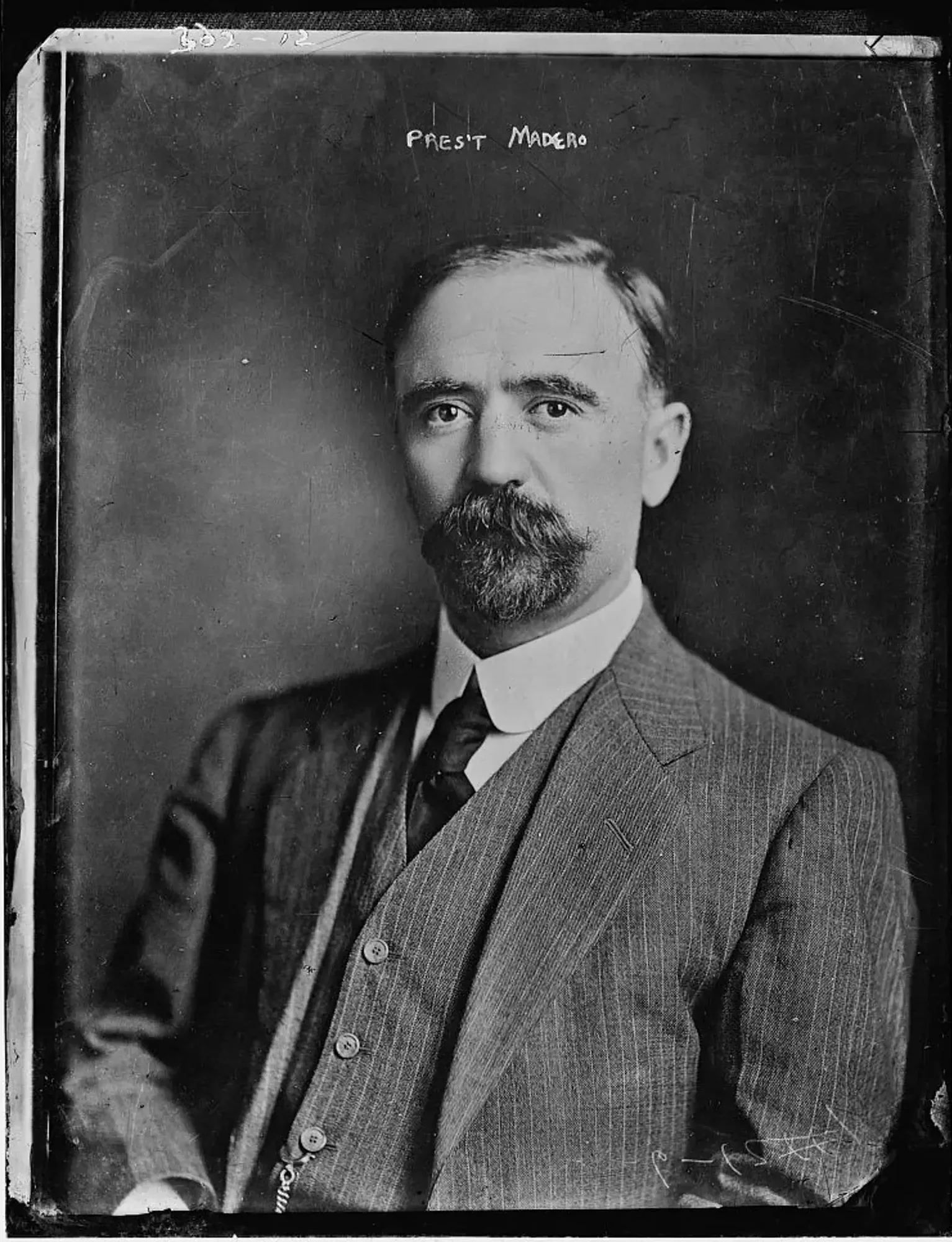
This Francisco Madero photo is a scan of an 8 × 10 inch glass negative from the Bain News Service collection at the Library of Congress, cataloged as “Pres. Madero” and carrying no date. Fine scratches cross the right side of the plate, the emulsion is lifting along the left edge, and the edges and corners are chipped. What follows is what the record says about the negative, what restoration repaired, and why the color is the model’s inference.
What the Francisco Madero photograph shows
A man sits for a portrait framed from the head to just below the vest, his shoulders turned slightly to one side and his eyes on the camera. He has short hair, a mustache and a short beard, and wears a pinstriped three-piece suit, a high white collar and a dark tie. A watch chain hangs across the vest at the lower left, and the backdrop is dark and cloudy.
At the top of the plate, someone wrote PRES’T MADERO by hand. The Library catalogs the negative as “Pres. Madero,” gives the date as “[no date recorded on caption card],” and notes that the title comes from “unverified data provided by the Bain News Service on the negatives or caption cards.” Its rights statement reads “No known restrictions on publication.”
Francisco I. Madero (1873–1913) was president of Mexico from November 1911 to February 1913. The collection the negative belongs to lists the Mexican Revolution among its subjects. The record gives no place and no photographer, so this page claims neither.
What happened to this negative
The Library keeps this portrait as a single glass negative, 8 × 10 inches (about 20 × 25 cm), and describes its digital file, LC-DIG-ggbain-01887, as made from the original negative. It sits in the Bain News Service photograph collection, which the Library dates 1860–1937, “bulk 1910-1920.” According to the Library, George Grantham Bain founded the first news photography service in 1898 in New York City.
The collection record counts about 40,000 glass negatives in the 4 × 5 and 5 × 7 inch sizes and about 710 in 8 × 10. This one is among the 710.
The name on it is the agency’s. The Library’s note calls the data unverified and does not say whether the title came from the plate or from a caption card. The plate reads PRES’T MADERO; the catalog title is “Pres. Madero.” The record names the Bain News Service as publisher and no photographer. We rely on the caption and on the Library’s title, and we did not verify the identification separately.
The date is missing at the source: the agency’s caption card recorded none. Our inference, not the catalog’s: the plate calls him president, Madero held that office from November 1911 to February 1913, and most of the collection dates from 1910 to 1920, so the portrait most likely belongs to those months. A caption can be written after the exposure, so read that as a likely window, not a date.
On the scan, the plate has fine scratches on its right side, emulsion lifting along the left edge, chipped edges and corners, and a dark border around the picture. A number is also written along the top edge; the record does not say what it is. Our guides to scratched photos and to restoring negatives cover these kinds of damage.
What was repaired, and where the color comes from
The restoration was generated with Gemini nano-banana 2.1 through our lab — a different image model from the one behind the restoration tool on this site — using the same analysis and instructions as that tool. We made three runs and show one. One came back nearly sepia; another kept the handwritten caption and a mottled backdrop. The one shown has the clean backdrop and the face closest to the negative, judged by eye and by our face-similarity measurement.
The scratches and the lifted emulsion are repaired, and the edges are clean. The handwritten caption does not appear in the result, so PRES’T MADERO survives only on the original scan; another run kept it. The model left a thin white margin at two edges, which we trimmed. The pose, the pinstripe of the suit, the watch chain and the dark backdrop are as the negative holds them.
The negative is black and white, so the color is inferred by the model, not recovered from the photograph. It chose a gray pinstripe suit, a dark tie with a burgundy tone, skin tones and a dark brown backdrop. None of that is in the plate, and any of it could have come out differently, as the sepia run showed. The black-and-white version on this page is the same result with the color removed in our lab; the restoration tool on this site returns a black-and-white photograph in color.
To check the face, hold the photograph to bring up the negative and compare the brows, the spacing of the eyes and the line of the mustache. Scratches across the emulsion, a lifting edge and a chipped corner turn up on family negatives and glass plates too.
Questions about the Francisco Madero photo
Is this a real photo of Francisco Madero?
Yes, as an object: the original is a glass negative held by the Library of Congress, and the plate has “PRES’T MADERO” written on it. The Library calls the title data from the Bain News Service “unverified,” so the identification rests on the agency’s caption. What is not original is the color; hold the photograph at the top of this page to see the original and compare.
Is there a real color photo of Francisco Madero?
Not in this record. The negative is black and white, and the color on this page was added by an AI model during the restoration. If you meet another colorized portrait of him, ask for the archive record, the date it gives and who chose the colors.
Who took the photograph of Francisco Madero?
The record does not say. It names the Bain News Service as publisher and names no photographer. According to the Library, George Grantham Bain founded the first news photography service in 1898 in New York City, and this negative sits in the collection that carries the service’s name.
When was this photo of Francisco Madero taken?
The record gives no date; its date field reads “[no date recorded on caption card].” The plate calls him president, and he held that office from November 1911 to February 1913, so our inference is that the portrait dates from those months. A caption can be written after the exposure, so treat that as a likely window.
Where is the original negative, and can I use it?
At the Library of Congress, under LCCN 2014681882: one glass negative, 8 × 10 inches, in the Bain News Service photograph collection. Its digital file is LC-DIG-ggbain-01887. The Library’s rights statement reads “No known restrictions on publication” and points to the collection’s rights page, which is worth reading before you reuse the image.
Sources
- Pres. Madero — Library of Congress, George Grantham Bain Collection
- Bain News Service photograph collection — Library of Congress, Prints and Photographs Division
A family portrait with fine scratches and a chipped edge?
Upload a scan of your own — a scratched negative, a worn corner, an edge that is lifting. When the result is back, hold the restored photo to see your original before you decide whether to keep it.
Free during early access · 2 restorations a day
Used only to restore your photo. How we handle your photo
Left alone on purpose
The pose, the pinstripe of the suit, the watch chain and the dark backdrop are as the negative holds them. The portrait stays undated and unattributed, as in the record: we gave it no date and no photographer, because the catalog names neither.