
- Photograph — Bain News Service glass negative; photographer not named
- Date and place — 1911 (year only); no place recorded
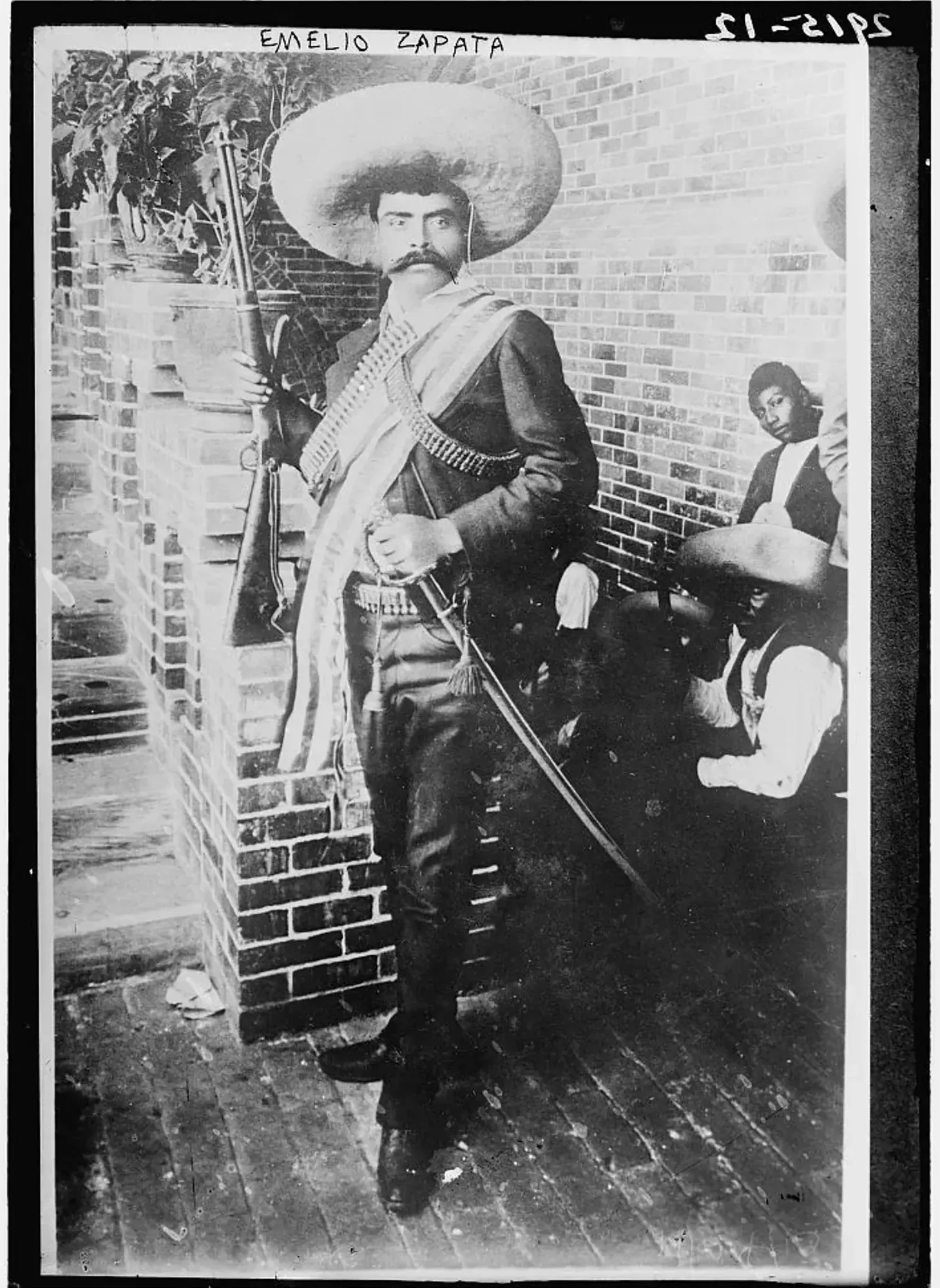
- Damage — Scratches, specks, uneven tone, dark border
- Archive — Library of Congress, LC-DIG-ggbain-14906
- Restoration — Epoha
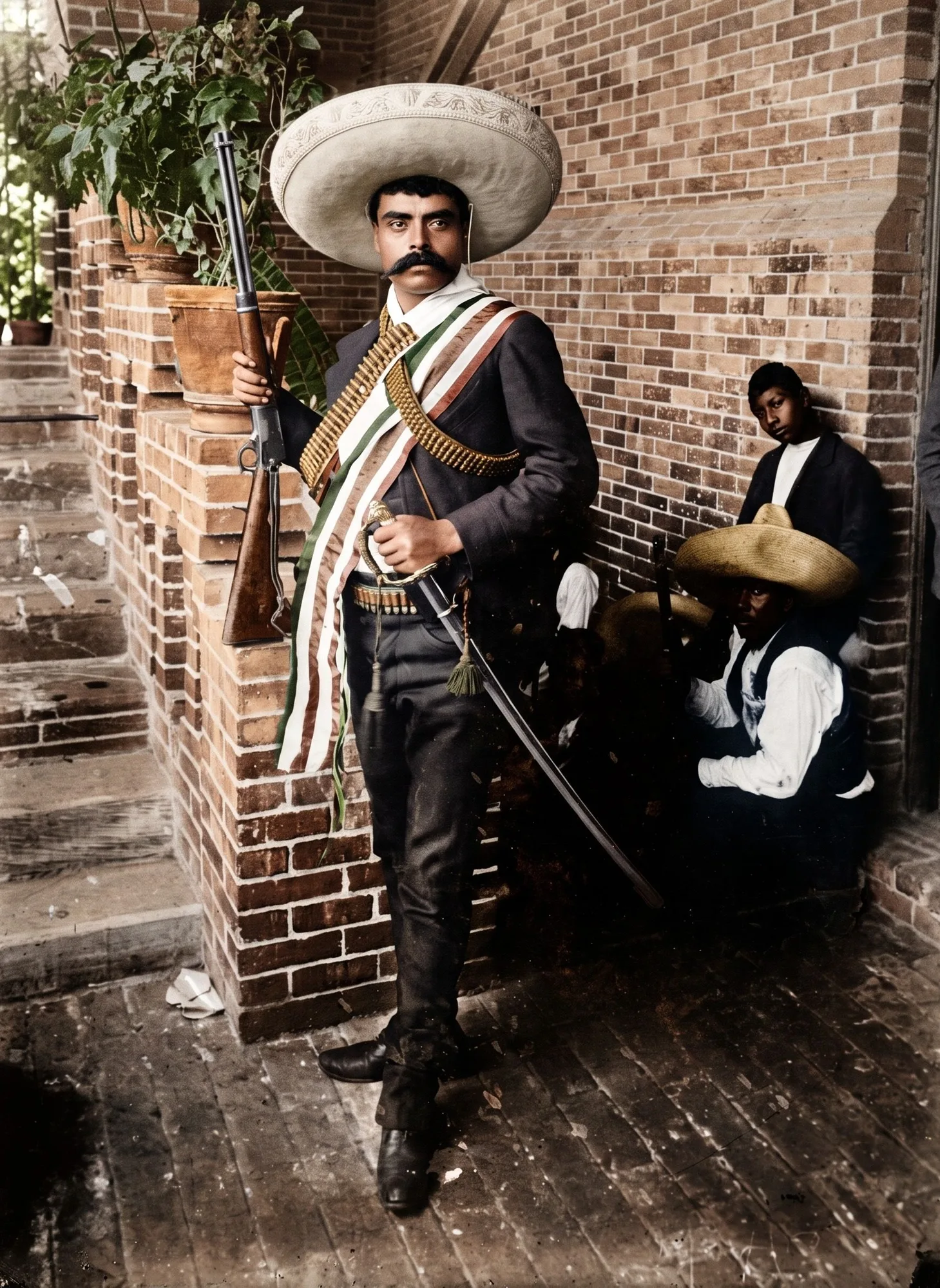
Emiliano Zapata, 1911
Emiliano Zapata colorized from a real 1911 glass negative at the Library of Congress: scratches and specks removed, color inferred by the model.
- Photograph
- Bain News Service glass negative; photographer not named
- Date and place
- 1911 (year only); no place recorded
- Damage
- Scratches, specks, uneven tone, dark border
- Archive
- Library of Congress, LC-DIG-ggbain-14906
- Restoration
- Epoha
Free during early access · 2 restorations a day
This Emiliano Zapata photo is real: a glass-plate negative from the Bain News Service collection at the Library of Congress, dated 1911 in the catalog and shown here restored and colorized. The plate is covered in scratches and specks, its tone is uneven, and a dark border runs around the picture. What follows is what the record says about the negative, what restoration repaired, and what the color is and is not.
What the Emiliano Zapata photograph shows
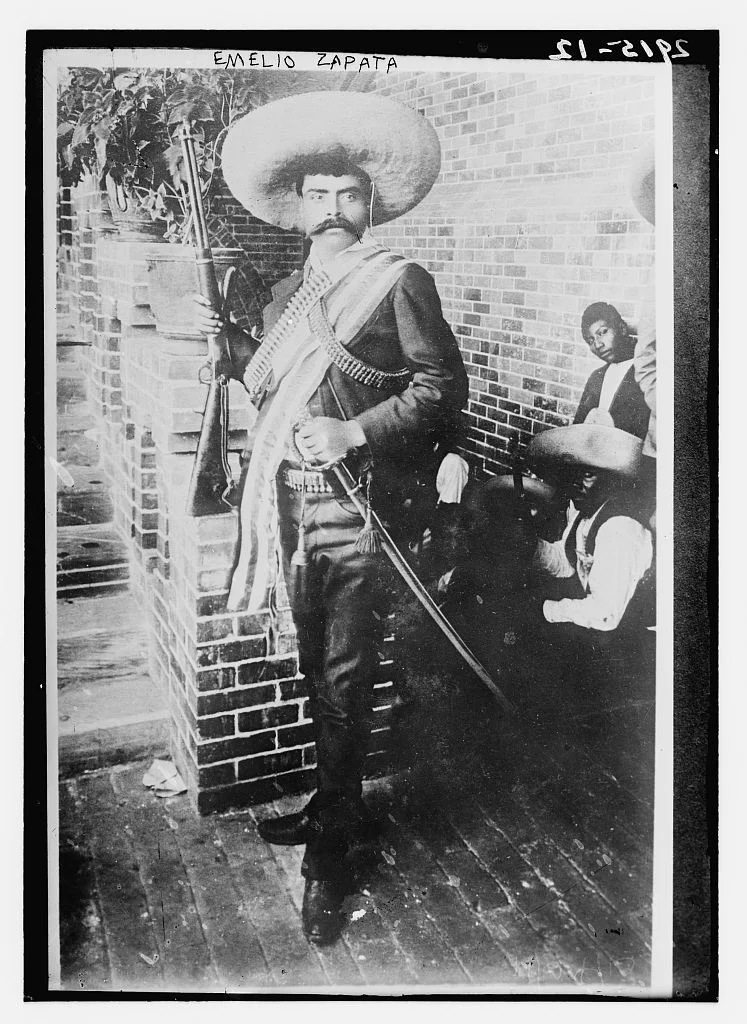
Zapata stands full length in the foreground, beside a brick pillar that holds potted plants. He wears a wide sombrero, cartridge belts across his chest and a striped sash. He holds a rifle upright in his right hand, and his left hand rests on the hilt of a saber that hangs at his side. Behind him on the right, one man crouches in a sombrero and another leans against the brick wall. Steps rise at the left of the frame.
The Library of Congress catalogs the negative as “Emelio Zapata” and dates it “[1911].” That spelling is handwritten on the negative itself, at the top left, with a number at the top right. The Library’s description says the photo shows “Emiliano Zapata Salazar (1879-1919), leader of the Mexican Revolution (1910-1920).” The record does not name the men behind him, a photographer or a place.
What the Library of Congress record says about the negative
The original is a glass negative, “5 x 7 in. or smaller” in the record’s words, so no exact size is given. The record is LCCN 2014694879, and the Library’s digital file, LC-DIG-ggbain-14906, was made from the original negative. The negative belongs to the Bain News Service photograph collection: about 40,000 glass negatives dated 1860-1937, most of them from 1910-1920, with the Mexican Revolution among its subjects.
The collection’s description says George Grantham Bain founded the first news photography service in 1898 in New York City, and that the Bain News Service accumulated photographs of world-wide coverage and distributed them to various newspapers. In this record the agency appears as publisher. No photographer is named, so we do not name one either.
The record also explains the title: “Title from data provided by the Bain News Service on the negative.” That is why the catalog keeps the spelling “Emelio”: it is the name as written on the negative. The Library’s own description spells the name Emiliano and credits the Flickr Commons project, 2010, as its source. The record says nothing more about how the sitter was identified or what the number on the negative means.
The date, “[1911],” is a year in square brackets, with no month or day. The rights statement reads “No known restrictions on publication.” In the Library’s scan, scratches and specks cover the plate, the tone is uneven and a dark border surrounds the picture; the record does not say what caused any of it. Our guide to scratched photos covers this kind of damage.
What was repaired, and how the photo was colorized
The restoration was generated with Gemini nano-banana 2.1 through our lab — a different image model from the one behind the restoration tool on this site — using the same analysis and instructions as that tool. We made five attempts: two failed with timeouts and returned nothing, and three produced images. We show the one whose face stayed closest to the negative, judged by eye and by a face-similarity measurement.
The scratches and specks are gone. The name and number handwritten on the negative are not in the result, because only the photograph comes back; the dark border is gone for the same reason.
The photograph comes back in color, and the color is inferred by the model: the negative was black and white, so it recorded light and shadow, not hue. In our result the brick is red, the sombrero light with an embroidered brim, the jacket dark, and the sash striped green, white and red. The sash is the clearest guess. In the Library’s scan it is a light band with darker stripes, and neither the photograph nor the record says which colors they were.
The tool on this site always returns color; the black-and-white “Restored” step in the strip under the photograph was made in our lab from the color result, and any photo editor can make one from yours. Holding the photograph to see the original is also how you check the face. There is no automatic comparison, so look at the faces yourself, all three, not only Zapata’s.
Questions about this Emiliano Zapata photo
Who took the photo of Emiliano Zapata?
The Library of Congress record does not name a photographer. It lists the Bain News Service as publisher and says the title came from data the agency provided on the negative. Anything more specific would be a guess, so this page does not make one.
Is this a real photo of Emiliano Zapata?
The original is. It is a glass negative held by the Library of Congress, titled “Emelio Zapata” and described in the catalog as showing Emiliano Zapata Salazar (1879-1919). The scratch repair and the color were done by an AI model; hold the photograph at the top of the page to see the Library’s scan.
Is the colorized Emiliano Zapata photo accurate?
The picture is the negative’s; the color is not a record. As with any colorized photograph from the Mexican Revolution, the original is black and white: it recorded light and shadow rather than hue, so the model inferred every color, including the green, white and red of the sash. Read the color as one plausible version, not as evidence of what he wore.
When was this photo of Emiliano Zapata taken?
The Library of Congress dates the negative “[1911]”: a year in square brackets, with no month, day or place. We use that date and nothing narrower.
Where is the original Emiliano Zapata negative?
At the Library of Congress, in the Bain News Service photograph collection. The digital file is LC-DIG-ggbain-14906, and its catalog record is linked at the top of this page and in the sources below.
Sources
- Emelio Zapata — Library of Congress, George Grantham Bain Collection
- Bain News Service photograph collection — Library of Congress, Prints and Photographs Division
A family print covered in scratches and specks?
Upload a scan of your own — a scratched print, a dusty negative. When the result is back, hold the restored photo to see your original before you decide whether to keep it.
Free during early access · 2 restorations a day
Used only to restore your photo. How we handle your photo
Left alone on purpose
Zapata’s pose, the rifle and the saber, the men behind him, the brick pillar and the plants are as the negative holds them. We did not change the composition or name the men at the back, because the record does not, and we did not guess what the number on the negative means.